
26 October 2026
How Long Does A Roof Last In Dartford? It Depends When Your Street Was Built
How long does a roof last in Dartford? Slate, clay, concrete and flat roof lifespans by house age, what fails first and when to repair or replace.
Ask how long a roof lasts in Dartford and the honest reply is another question: when was your house built, and has the roof been redone since? A Welsh slate roof on a terrace near the town centre can still be keeping the weather out after 120 years. The felt on a garage behind it might be finished at 20. Dartford is also kinder to roofs than most of the country. The Met Office puts yearly rainfall around the Thames Estuary at under 550mm, and air frosts at fewer than 30 a year in places close to it. Fewer frosts means less of the freeze-thaw cracking that wrecks tiles further north. It does nothing for rusting nails, crumbling mortar or brittle felt, though, and those usually decide when a roof is done. This guide goes through each type of roof you’ll find in the borough, what tends to fail on it first, and how to tell whether yours has years left or needs replacing.
How long does a roof last in Dartford? Start by dating yours
The age of the house and the age of the roof are often two different numbers. Lots of Edwardian terraces here were stripped and re-covered in concrete tiles sometime in the 1960s, 70s or 80s, so the covering is half the age of the walls.
The loft tells you most of what you need. Go up with a torch and look at the underside of the roof:
- Nothing between the rafters but the backs of the slates or tiles, maybe with old lime mortar smeared between them. That’s very likely the original pre-war roof.
- Black bitumen felt draped between the rafters, which points to a roof laid somewhere between the 1950s and the 1990s.
- A thin, papery sheet, often grey or white with a maker’s name printed on it. That’s a breathable membrane, and it usually means the roof was done in the last 25 years or so.
Outside, concrete tiles on a Victorian house give it away as a replacement, and a mix of tile colours on one slope suggests it has been patched more than once. If you’d rather someone else did the crawling, a roof inspection in Dartford will date the covering and write down what is wearing.
As a starting point, here is roughly what each covering lasts when it’s fitted properly:
| Roof covering | Typical life | What tends to give up first |
|---|---|---|
| Welsh slate | 100 years plus | Iron nails, original battens |
| Clay plain tiles | 60 to 100 years | Snapped nibs, ridge and hip mortar |
| Concrete interlocking tiles | 50 to 60 years, sometimes more | Worn tile surface, old felt at the eaves |
| Torch-on felt (flat) | 15 to 25 years | Splits, blisters, upstands |
| EPDM rubber (flat) | 20 to 40 years | Edge trims, badly made joints |
| GRP fibreglass (flat) | 20 to 30 years plus | Cracking where the deck moves |
Welsh slate on Dartford’s Victorian and Edwardian terraces
The terraces either side of the town centre and climbing West Hill were mostly roofed in Welsh slate when they went up. Slate splits into thin, dense sheets that take in almost no water, so frost has very little to grip on, and on Dartford’s relatively dry, mild winters a good slate can outlast the house.
The nails are another matter. Victorian roofers fixed slates with iron nails, which rust through over the decades until slates start sliding out of line one by one. Roofers call it nail sickness. A few slipped slates held back with small lead or copper strips, known as tingles, is ordinary upkeep. Dozens of tingles scattered across both slopes tells you the nails are going everywhere, and the battens they are driven into are probably just as old and soft.
At that point the slates themselves are rarely the problem. A roofer can usually strip them, sort out the sound ones and re-lay them with copper nails over new battens and a breathable membrane, making up any shortfall with matching reclaimed slate. If your house sits in one of the borough’s conservation areas, which include Dartford Town Centre and Greenhithe, look at Dartford Borough Council’s conservation area pages before you think about swapping slate for something cheaper.
Clay plain tiles on the interwar semis of Wilmington and Joyden’s Wood
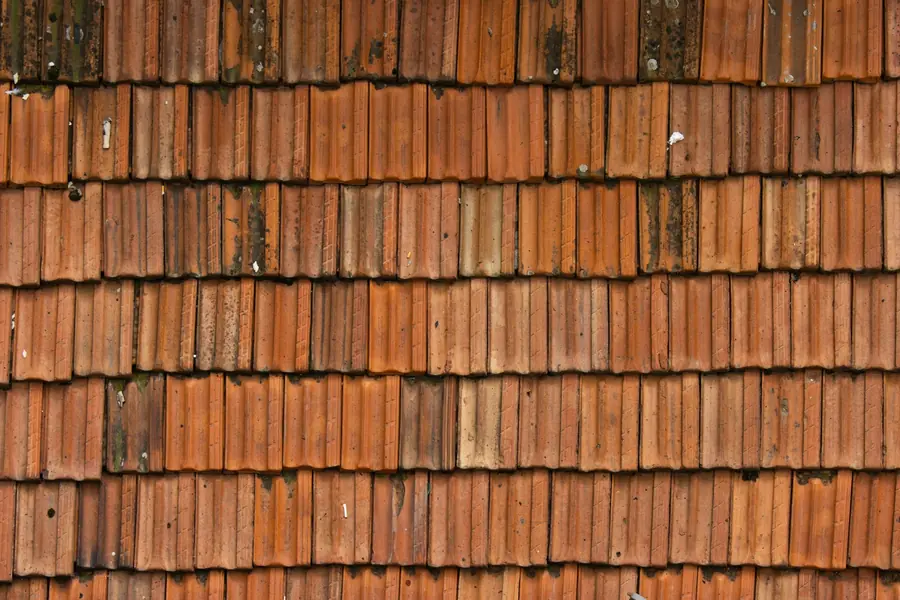
Head south of the town and the 1930s housing takes over: bay-fronted semis in Wilmington, bungalows and chalets in Joyden’s Wood. A lot of these were covered in small, flat clay plain tiles, each one hooked over a batten by two little lugs, or nibs, on the back, with only some courses nailed.
Good clay plain tiles last somewhere between 60 and 100 years, and many of the originals here are now about 90. Their weak points are the nibs, which snap with age so that tiles slide down the slope, and the mortar bedding the hip and ridge tiles, which cracks and lets the tiles rock. In wetter, colder parts of England you also see the faces of clay tiles flaking off after repeated freezing. Here that’s less common, though north-facing slopes under trees still suffer.
Many of these roofs were laid with no felt at all. The tile overlap kept the rain out, and a little dust or wind-blown snow in the loft doesn’t mean the roof has failed. What matters is whether the slipped tiles are a handful in one corner, which is a repair, or spread across every slope, which means the battens and fixings are worn out across the board.
Concrete interlocking tiles on Temple Hill and the postwar estates
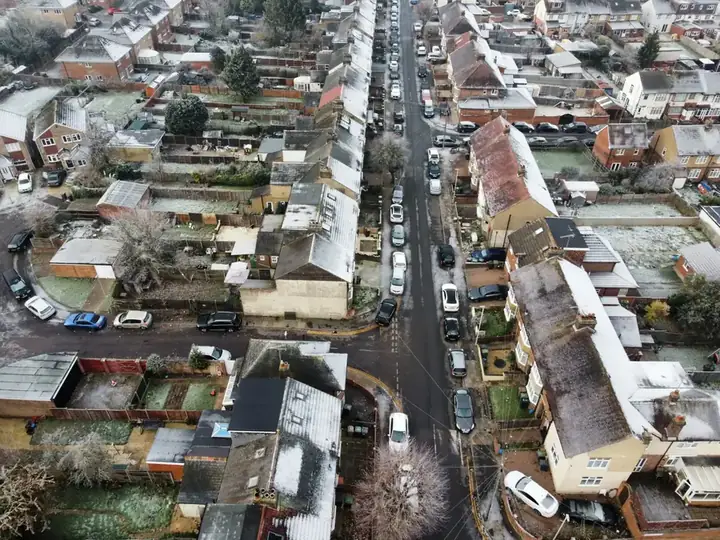
After the war, concrete tiles became the default. They were cheap, quick to lay and could go on at shallower pitches than clay. Temple Hill, the 1950s to 70s estates across the borough, and all those re-covered Victorian terraces mostly carry them.
Expect 50 to 60 years from a concrete tile, sometimes a good deal more. As they age, the smooth coloured surface wears away and the tile underneath turns porous. It holds more water, grows more moss, gets heavier and can start to crumble along the edges and nibs. A lot of the original postwar roofs in Dartford are at or past that mark now.
The tiles are often in better shape than what’s under them, though. First-generation bitumen felt goes brittle and tears where it runs over the fascia into the gutter, so rain blown under the bottom courses ends up rotting the timber at the eaves instead of draining away. If the loft is dry, the felt is intact and the tiles still ring hard when tapped, a 55-year-old concrete roof can keep going for a good while yet.
What wears out before the tiles: mortar, felt, battens, lead and nails
Very few roofs in Dartford fail because the covering itself is worn out. The parts that hold it together usually go first.
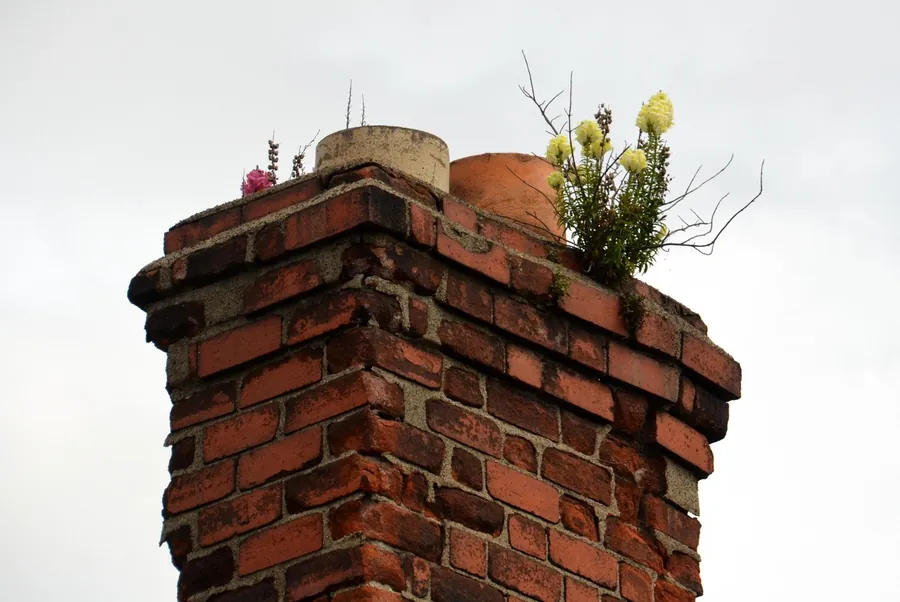
Sand and cement bedding under the ridge, hips and verges shrinks and cracks as it ages, and somewhere between 20 and 40 years in, most roofs need some of it re-bedded. The flaunching on top of a chimney, the mortar collar holding the pots, goes the same way. Once it cracks, water gets into the brickwork and weeds move in, as on the stack in the photo.
Under the tiles, old bitumen felt sags and splits after a few decades, worst of all at the eaves. Untreated softwood battens on older roofs go soft and stop gripping their nails. And the nails themselves matter more than anyone gives them credit for: iron rusts, galvanised steel lasts longer, and copper or aluminium are what you want for re-fixing slate.
Lead is the odd one out. A properly fitted lead flashing can last as long as the roof does. When it fails, it’s usually because a length was cut too long and cracked as it expanded and shrank, because the pointing holding it into the wall has dropped out, or because someone used a cement fillet where lead should have been.
The local weather is mostly on your side. The Met Office climate summary for southern England describes the Thames Estuary as the most sheltered part of the region from rain-bearing south-westerly winds. It still has its moments. Kent and the estuary are prone to heavy snow showers on north-easterly winds, and in January 1987 more than 35cm of snow lay on either side of the estuary. The Great Storm that October was the worst to hit the region since 1703. Summer heat counts too: Faversham reached 38.5°C in August 2003. Long hot spells dry out mortar and felt, and the odd big gale finds whatever is already loose.
Newer homes at Ebbsfleet, Stone and Greenhithe
The riverside estates are a different case. The Bridge, Ingress Park and the newer Ebbsfleet neighbourhoods inside Dartford borough are mostly roofed with concrete interlocking tiles on trussed rafters, over a breathable membrane. The tiles on a house built in 2005 should have decades in them.
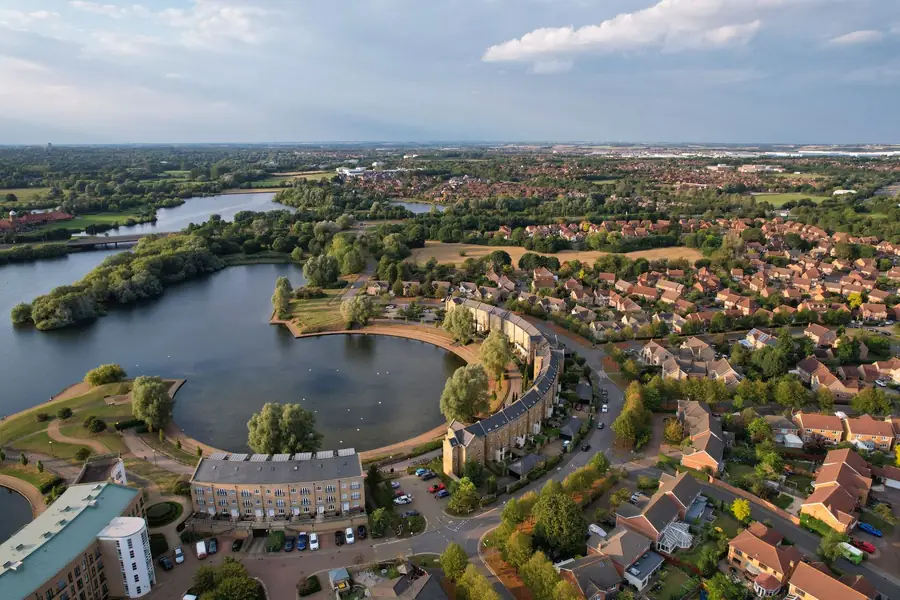
What doesn’t last that long is the dry-fix hardware. Instead of mortar, most of these roofs use plastic verge caps, clipped ridge units and screw fixings, and that kit tends to give 15 to 25 years before sunlight turns the plastic brittle and the clips work loose. A rattling verge or a ridge tile lifting in the wind on a 20-year-old house is a repair job. It doesn’t mean the roof needs replacing, and anyone telling you otherwise should explain why. Our guide to checking a new-build roof once the NHBC cover runs out covers the usual suspects in more detail.
Flat roofs on Dartford extensions, garages and dormers
Flat roofs age fastest of anything on a house. Built-up torch-on felt usually manages 15 to 25 years, EPDM rubber 20 to 40 and GRP fibreglass 20 to 30 or more, assuming each was laid properly on a sound deck.
A few things cut those figures short. Water that sits in puddles for days after rain speeds up wear and finds any weak joint. Chipboard decks, common on older extensions, swell and go soft once damp gets in, and then no membrane on top will last. A south-facing roof also gets the full force of a hot Kent summer, which ages felt quickly. People walking on the roof to clear gutters or reach a window do their share of damage too.
The giveaways are blisters, cracks running across the surface, a spongy feel underfoot and upstands peeling away from the wall. If you’re weighing up whether to patch or replace, our breakdown of flat roof costs in Dartford shows how the three materials compare.
Signs a Dartford roof is near the end, and when to repair instead
Most roofs give plenty of warning. These are the signs worth taking seriously:
- Slates or tiles slipping on more than one slope, or a roof covered in tingles
- Tiles that are soft, flaking or thick with moss across the whole slope, not just in one shady corner
- Daylight through the roof from the loft, damp stains on the rafters, or felt hanging in shreds at the eaves
- A ridge line that dips, or slopes that sag between the rafters, which needs looking at straight away
- Repairs in a different place every winter
The repair or replace decision mostly comes down to whether the fault is in one spot or everywhere. A cracked ridge, a tired valley or one leaking chimney is a repair, however old the roof is. When the same fault turns up across every slope, you’re paying for scaffold again and again to patch a roof that has worn out all over, and replacing it is usually the cheaper option over ten years. Our full re-roof price guide for Dartford sets out the 2026 figures by house type, and the roof repair costs guide prices the smaller jobs, so you can compare the two honestly.
Frequently asked questions
How long does a slate roof last on a Victorian house in Dartford?
Welsh slate itself commonly lasts well over a hundred years, and plenty of terraces in Dartford still have their first slates. What gives out sooner are the iron nails and the original battens. Once slates start slipping across several parts of the roof, the fixings are failing generally, and the usual answer is to strip, sort and re-lay the good slates on new battens and membrane.
Is a 50-year-old concrete tile roof worn out?
Not automatically. Concrete interlocking tiles usually manage 50 to 60 years, sometimes longer. If the loft is dry, the roof line is straight and the tiles are still hard rather than soft and flaky, it may have years left. The felt underneath is often in worse shape than the tiles, so check it from the loft, especially down at the eaves.
How long does a flat roof last on a Dartford extension or garage?
As a rough guide, torch-on felt gives 15 to 25 years, EPDM rubber 20 to 40 and GRP fibreglass 20 to 30 or more. Standing water, a weak deck and hot summer sun on a south-facing roof all shorten those figures. A garage roof that is still the original felt from decades ago is almost certainly living on borrowed time.
Does Dartford's weather make roofs last longer?
For tiles and slate, it helps. The Met Office records under 550mm of rain a year around the Thames Estuary and fewer than 30 air frosts a year close to it, so there is less freeze-thaw damage than in much of the UK. Summer heat still dries out felt and mortar, and the occasional severe gale will find any loose ridge or verge.
Want a Dartford roofer to look at yours?
A roofer will come out, check it from the loft and the outside, and give you a written price. Dartford, Crayford, Bexley, Swanley and nearby.